Nintendo has teased the launch of a new Nintendo Switch accessory that will be officially unveiled on September12.
from RSS Feeds | GAMES - RSS Feed - NDTV Gadgets360.com https://ift.tt/2PQbM33

Death Stranding will have a Very Easy Mode For Movie Fans: Kojima
Calling Death Stranding one of the most anticipated games of this generation would be an understatement. It is made by the legend behind the Metal Gear Franchise, Hideo Kojima is slated to launch for the PS4 on November 8 and is powered by Gorilla Games Decima Engine, the same engine used for Horizon Zero Dawn. Considering the star cast and cinematic nature of the game, Kojima tweeted, “Normally there’s only Easy Mode, but we added Very Easy Mode for movie fans since we have real actors like Norman, Mads, Lea starred in. Even Yano-san who never completed the 1st stage of PAC-MAN, was able to complete the game on Very Easy Mode.”
The internet has been abuzz about the Very Easy mode coming into the game. Some responses are positive and happy that the game is accessible for those that aren't good at video games. Others are mocking the mode tweeting that it should be called “journalist mode”.
It’s important to note that games usually have varying difficulties to cater to a larger audience of gamers. There are games like the Souls series or Sekiro which are meant for those that would like a challenge when gaming. There are also games like Control which do not have difficulty but are challenging enough for the average gamer.
Coming back to death stranding, the game is just around the corner, scheduled to release on November 8 and we still don't know what the game is about. Numerous trailers gameplay videos of the game have been released and each leading to more questions about the game. Is this Hideo Kojima at his finest or have we set our expectations too high? We will know in a mere 62 days.
Normally there’s only Easy Mode, but we added Very Easy Mode for movie fans since we have real actors like Norman, Mads, Lea starred in. Even Yano-san who never completed the 1st stage of PAC-MAN, was able to complete the game on Very Easy Mode

from Latest Technology News https://ift.tt/31cA5tz
Apple to stream iPhone 11 launch on YouTube, a first for the company
Apple is expected to launch its new iPhones to the world on September 10. Traditionally, one who can't physically attend the event can do so by watching the event live on their iPhones, iPads, Apple TV devices or the safari browser on their Mac. If you are a Windows user, you'd have to log onto the Edge browser to watch the event. This is the first time in the history of Apple that the company is broadcasting the event live on YouTube.
The Apple YouTube page has the video with a title that reads, “Apple Special Event. Watch Live on YouTube” The descriptor reads, “Cupertino calling. Join us for an Apple special event live from the Steve Jobs Theater on September 10 at 10 a.m. PDT. Set a reminder and we’ll send an update before the show.”
Information about the upcoming iPhones has been leaking online for some time now. Apple is expected to launch three iPhones - the iPhone 11, iPhone 11 Pro and the iPhone 11 Pro Max.
The first phone in this year’s lineup is rumoured to be the iPhone 11, the direct successor to the iPhone XR. According to the leaked specs, it would come with a 6.1-inch IPS LCD display with a resolution of 1792x828. The phone is expected to sport a glass design and come packing a 3110mAh battery. This time around, rumours suggest that the iPhone 11 would come with dual 12-megapixel cameras on the rear.
The next is the Pro duo, the iPhone 11 Pro and iPhone 11 Pro Max. These phones are expected to have a 5.8-inch and 6.5-inch OLED display respectively. Camera duties will be spread across three shooters, each with a 12megapixel sensor, although we’re not sure what the lens configuration will be like. An educated guess points towards the possibility of Apple finally adding an ultra-wide-angle lens to its existing camera stack. The two Pro models are expected to bring support for the Apple Pencil, reverse wireless charging and a frost glass design.
Sadly, the iPhone 11 won’t get reverse charging or the Apple Pencil support, but all three phones, according to the leak, will support WiFi 6. While the iPhone 11 will sport 4GB RAM and the Pro models 6GB of RAM, all three phones will be powered by Apple’s new A13 SoC.
Those interested can watch the Apple iPhone Keynote below.

from Latest Technology News https://ift.tt/2ZNLana
Huawei Mate X foldable phone could go on sale as early as next month, two versions incoming
It looks like the era of the foldable phones has begun. Samsung relaunched the Galaxy Fold after a rocky initial launch and it looks like Huawei is all set to launch its Mate X foldable phone in October 2019. At IFA 2019 it was revealed that Huawei will launch two versions of the Mate X. One will be powered by the Kirin 980 SoC and the other by Kirin 990 SoC. The Kirin 980 powered Mate X was first spotted back at MWC 2019. It isn't clear whether there will be any other differences between the two versions of the device.
Speaking of other specifications of the Mate X, the main is an RYYB, like the Huawei P30 Pro, which results in a better low-light performance. It could feature two FullView Display panels of 6.6-inch and 6.38-inch sizes. They can create an 8-inch OLED FullView Display panel with a resolution of 2200x2480 pixels when unfolded, and a 6.6-inch display with a resolution of 1148x2480 pixels and an aspect ratio of 19.5:9, when folded.
The foldable smartphone packs a 4,500mAh battery, which supports proprietary fast charging. The Mate X expected to come with 6GB, 8GB, or 12GB RAM options, and 128GB, 256GB, or 512GB storage options, with support for expandable memory up to 256GB via Huawei’s Nano Memory card.
Unlike the Samsung Galaxy Fold which houses the larger display on the inside of the fold, the full display on the Mate X is on the outside. There is no information on when the device is expected to come to India.
Source

from Latest Technology News https://ift.tt/2HPRBfa
ISRO loses communication link with Vikram lander during final stages of descent
Communications was lost with the Vikram lander in the last few nail biting minutes of the controlled descent. ISRO had successfully executed most of the soft landing near the south pole of the Moon with the Vikram lander, as part of the Chandrayaan 2 mission, but the spacecraft appeared to veer off course just towards the end. A period of confusion followed, where ISRO personnel indicated that they were not recieving any communications from the spacecraft. Officially, ISRO Chairperson K Sivan said, “Vikram lander descent was as planned, and normal performance was observed up to an altitude of 2.1 kilometer. Subsequently, the communications from the lander to ground station was lost. The data is being analysed.” There are also some indications from the trajectory that there was an attitude correction manoeuvre. The landing was the trickiest part of the mission, and the most technically sophisticated operation undertaken by ISRO in its history. One of the primary objectives of the mission was to demonstrate the capability of being able to execute a soft landing. Those of you who have been watching the live stream know that even at this late hour, the country was awake and preparing for a celebration. Prime Minister Narendra Modi was at the ISRO control center in Bengaluru, along with 60 school students from across the country who participated in the 'Space Quiz' contest to get a chance to be a part of this historic moment.
Fifteen Terrifying MinutesThe site of the landing was a high plane between the Simpelius N and Manzinus C craters, at a latitude of 70.9° South and a longitude of 22.7° East. An alternative landing site was 67.7 ° South 18.4° West, and perhaps things could have played out differently if this site were chosen. Vikram had a touchdown velocity of 2 meters per second. Considering the velocity, there was a chance that the lander could have crashed into the Moon, topple over or be unable to communicate, if things did not go exactly as planned. The landing site also had to be carefully chosen to eliminate any chance of Vikram ending up in an area of communications shadow, because of the local terrain. Ahead of the launch, K Sivan described the tricky operation, “these fifteen minutes are going to be the most terrifying for all the people who belong to ISRO, probably for the scientists and the people in India also. This is going to be the most difficult task ever undertaken by ISRO in a mission”. During the entire fifteen minutes, the thrusters had to be perpendicular to the surface of the Moon. The ISRO scientists also had to compare the images from the lander to previous images to make sure that the exact landing site did not have an inclination of more than 12 degrees. If the inclination was more, then Vikram would have toppled after the landing. The lander went through thorough drop testing at a specially designed test facility in Chitradurga, that simulated the terrain of the moon.
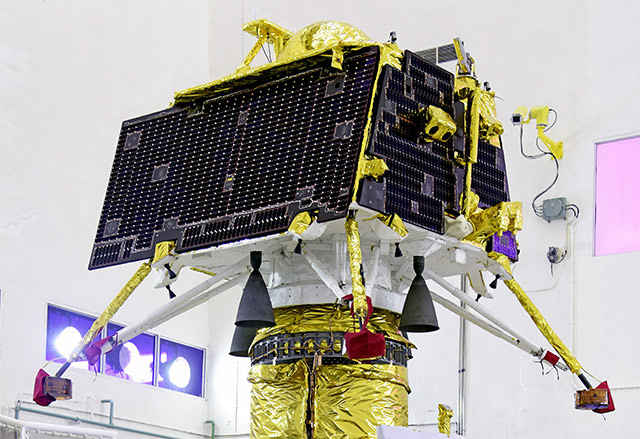
The Vikram Lander. Image: ISRO
The descent operations started from an altitude of 30 kilometers. The entire landing sequence was autonomous, without any command and control from the ground stations. The algorithms that were necessary to execute the soft landing were entirely developed by ISRO. The final trajectories for the lander were loaded four hours before the descent operation commenced. There were four phases to the descent, the rough braking phase, the attitude and absolute navigation control phase, the fine braking phase, and the terminal descent phase. The first phase brought down the lander from an altitude of 30 kilometers to 7.4 kilometers, the second phase brought down Vikram to 5 kilometers, the third to 400 meters, and the final phase gradually executes the touchdown, where the lander only moves vertically. 800 N of thrust were generated by the four engines on board. The steerable engines performed admirably during the controlled descent. Unfortunately, in the third phase of the landing, communication was lost with the Vikram lander. There is still hope though, it may be possible to reestablish communications. We do not yet know if the lander is just experiencing a communications problem, or something else has gone wrong. The data will have to be analysed to check if the algorithm was responsible for the lander veering off course, or there was some other reason. The four extendable legs on the lander were intended to dampen the impact and protect the sensitive instruments on board, as well as the Pragyaan rover. At this point of time, it is unknown if the landing was successfully executed. More details are awaited. As the PM noted though, it was no mean feat by ISRO scientists even to get as far as they did.
India is proud of our scientists! They’ve given their best and have always made India proud. These are moments to be courageous, and courageous we will be! Chairman @isro gave updates on Chandrayaan-2. We remain hopeful and will continue working hard on our space programme.
— Narendra Modi (@narendramodi) September 6, 2019

from Latest Technology News https://ift.tt/2zVG3CU
Phone numbers of millions of Facebook users was reportedly available in an open online database
Ever since the Cambridge Analytica fiasco, Facebook has been struggling to prove itself as a privacy-focused company. While Mark Zuckerberg promised that the social media platform will be better, it doesn’t seem like this is happening right now as TechCrunch has reported finding ‘hundreds of millions’ of phone numbers linked to Facebook accounts online. As per the report, an unprotected server with multiple databases and over 419 million user records that spanned across geographies existed online. The server is said to feature 133 million, 18 million and more than 50 million records of Facebook users based in the US, U.K., and Vietnam respectively.
Records in the database are said to contain a unique Facebook ID for each user, along with their phone numbers. The phone number and the associated ID could be used to link and find a user’s account on the social media platform and TechCrunch claims to have done exactly the same by verifying some of the records using the provided number and matching it against the Facebook ID. Using Facebook’s password reset feature, which partially reveals a phone number, the publication says it again managed to verify some of the records. In some cases, the record would also contain additional information like a user’s name, gender and location by country.
This latest open database with user data of Facebook users was reportedly discovered by a security researcher, Sanyam Jain. After contacting the host of the database to find out who its owner is, it is said to have been taken down. Facebook stopped displaying phone numbers for more than a year now and a Jay Nancarrow, a spokesperson from the company, told TC that the said data was obtained before the social media platform decided to restrict access to users’ cell phone numbers.

from Latest Technology News https://ift.tt/34uSrrG
Huawei announces Kirin 990 5G with 16-Core Mali-G76 GPU
A few days ago, Samsung announced the Exynos 980, the company’s first processor with an integrated 5G modem. Now, at IFA 2019 Huawei has unveiled the Kirin 990 5G, which it is calling "industry's first 5G SoC." Further, the company claims that Kirin 990 5G is the best in class chipset in terms of power efficiency. The Huawei Kirin 990 5G is made from a 7nm manufacturing process. It consists of nearly 10.3 billion transistors, which is 6.9 billion more than its predecessor, Kirin 980.
The Kirin 990 5G features a refreshed CPU architecture with two Cortex-A76 2.86 GHz cores, two Cortex-A76 2.36 GHz cores that juggle everyday workload and four Cortex-A55 1.95 GHz cores efficiency cores for lighter tasks. Huawei claims that Kirin 990 5G offers a 10 percent single-core and 9 percent multi-core performance advantage as compared to the Qualcomm Snapdragon 855 chipset.
The Kirin 990 5G sports a Mali-G76 GPU for the graphics needs. It has been optimised to pack 16 cores, which is six more than the Kirin 980. Huawei claims that the Mali-G76 GPU offers a 6 percent overall performance boost and 20 percent power efficiency boost as compared to the Snapdragon 855.
The new chipset also features an improved dual-image signal processor (DISP) for better photo-taking capabilities as compared to the Kirin 980. Huawei has said that the new DISP can reduce noise in still images by up to 30 percent and by up to 20 percent in videos.
The Kirin 990 5G features an improved Neural Processing Unit (NPU) that is said to boost the ETH AI benchmark by up to 4.76 percent than the Kirin 980.
Additionally, Kirin 990 5G will be the first all-in-one, full-frequency 5G chipset to hit the markets. The company claims that Kirin 990 5G’s split uplink design and machine learning-based adaptive receiver will help boost 5G speeds in places of "high-movement" and weak signal-strength, for example, cars, trains and more. In theory, the Kirin 990 5G is capable of delivering 1.25 Gbps upload speeds and 2.3 Gbps download speeds.

from Latest Technology News https://ift.tt/2ZTU9n7
Subscribe to:
Posts (Atom)
Edit videos on your mobile phone using the YouTube Create App
YouTube has introduced its new mobile app called ‘YouTube Create’. This app offers an easy way for creators to edit their videos right from ...

-
The Drone Racing League (DRL) is set to launch a hyperreal metaverse game Project Drone Galaxy, and an official trailer of the game was rele...
-
Paytm is once again hosting its Maha Cashback Sale on Paytm Mall and there are a bunch of good smartphone deals one can grab on sale days -...
-
Luxurious and powerful, the Marshall Woburn III stuns with premium looks and impactful sound at first. However, delve deeper and you’ll find...

