flipkart

Vivo NEX 3 sports 996 screen-to-body ratio: Vivo NEX Product Manager

The Vivo NEX line of smartphones has always been about fancy (and sometimes multiple) displays. Achieving a 100-percent screen-to-body ratio is the big dream for every smartphone manufacturer but poses undoubtedly many challenges along the way. But according to a social media post published by a Vivo NEX Product Manager on Weibo, Vivo may be very close to that much-coveted 100-percent mark. The upcoming Vivo NEX 3 is expected to feature a display with a screen-to-body ratio of 99.6 percent.

As reported by https://ift.tt/30f4KoF, Vivo NEX Product Manager Li Xiang's post on Chinese social media website Weibo reads, “NEX3's screen-calculated data of 99.6% is calculated according to the general calculation method of the industry, that is, the front display area/cover projection area. There may be some other algorithms, but it doesn't matter.” Even with a 0.5-percent margin of error, the Vivo NEX 3 will sport a display that has over a 99-percent screen coverage on its front face.
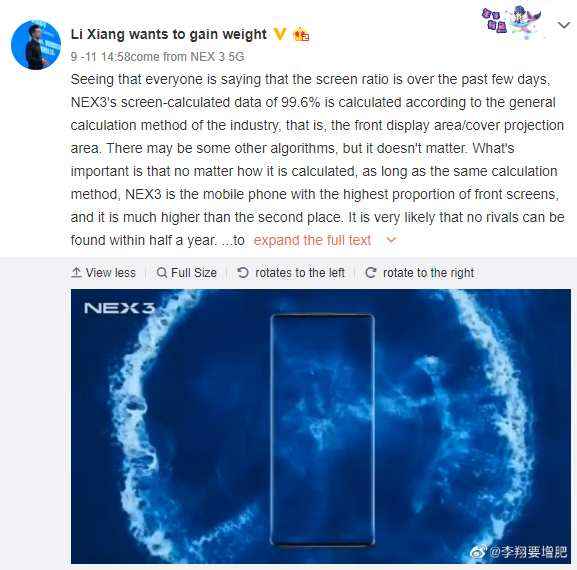
To achieve such a high ratio, the display of the Vivo NEX 3 is expected to flow over the sides of the body, thereby eliminating the left and right bezels altogether. An extremely slim bezel is, however, expected to run along the top and bottom of the smartphone. The Vivo NEX 3 is thus expected to come with a 6.89-inch curved AMOLED screen with a resolution of 1080 x 2256 pixels. Vivo is expected to call this a “waterfall screen”.

The complete spec sheet of the upcoming Vivo NEX 3 surfaced online last week (once again on Weibo). According to the sheet, the Vivo NEX 3 will be joined by a 5G-enabled variant called Nex 3 5G, featuring Qualcomm's latest Snapdragon 855+ chipset with up to 12GB of RAM and 512GB of internal storage space. The upcoming Vivo smartphone is also expected to feature a 64MP primary rear camera, a 13MP selfie camera, and a 4410mAh battery, among other features. The variant without 5G, however, is said to pack a 4500mAh battery with support for 44W fast-charging. The Vivo NEX 3 will be launched on September 16.


from Latest Technology News https://ift.tt/2ZYvJsn

OnePlus 7T, 7T Pro detailed specs, launch date leaked

It appears like OnePlus is gearing up to launch two new smartphones. After the leaks showcasing how the two devices may look like, now the specifications of OnePlus 7T and OnePlus 7T Pro have reportedly leaked online. It comes from Twitter tipster Steve H. McFly. OnePlus 7T is said to sport the same display as the OnePlus 7 with the small notch at the top of the display. 

OnePlus 7T, OnePlus 7T Pro leaked specifications 

While the OnePlus 7T is said to feature a 6.5-inch FHD+ (2400x1080 pixels resolution) Fluid AMOLED display, OnePlus 7T Pro is tipped to feature a 6.65-inch QHD+ (3100x1440 pixels) Fluid AMOLED display. Both the smartphones are said to come with a 90Hz refresh rate and HDR10+ support. They are expected to be powered by the Qualcomm Snapdragon 855+ chipset, paired with Adreno 640 GPU. 

OnePlus 7T and OnePlus 7T Pro are tipped to sport 8GB RAM. While both smartphones are rumoured to have a 256GB storage variant, OnePlus 7T may also have a 128GB storage model. Both the smartphones are expected to have an in-display fingerprint reader.

On the optics front, both OnePlus 7T and OnePlus 7T Pro are tipped to sport a triple rear camera setup, including a 48MP primary camera with f/1.6 aperture, EIS ad OIS. OnePlus 7T is said to come with a 12MP telephoto secondary camera with f/2.2 aperture and 2x zoom + a 16MP ultra-wide lens with f/2.2 aperture and 120° FOV). In contrast, OnePlus 7T is reported to have an 8MP secondary telephoto lens with f/2.4 aperture and 3x zoom + a 16MP ultra-wide camera with f/2.2 aperture and 120° FOV.

The OnePlus 7 is said to have a 3800mAh battery, whereas OnePlus 7T Pro is expected to pack a 4085mAh battery. Both the smartphones are tipped to have support for Warp Charge 30T.

Previously, OnePlus 7T was also spotted on Geekbench running Android 10.

OnePlus is rumoured to launch the 7T and 7T Pro on October 10, with sales commencing from October 15.


So... Today, I bring you #OnePlus7T and #OnePlus7TPro complete specs sheet as well as launch and availability date, on behalf of my Friends over at @compareraja -> https://t.co/7TrVeEYo7A pic.twitter.com/zEQuB3EP2G

— Steve H.McFly (@OnLeaks) September 13, 2019


from Latest Technology News https://ift.tt/31wxsTz

Google camera 70 apk for Pixel 4 leaked, Motion Blur, Audio Zoom, and more features revealed

Google revealed a teaser image with the back panel design of Pixel 4 in the hope to restrict the number of leaks surrounding the upcoming Pixel lineup. However, the rumour mill is still spilling out information about the Pixel 4 lineup. Thanks to a shop in Vietnam, the Google Pixel 4 series have reportedly fallen into the hands of local YouTubers who have already recorded first impressions of the phones. It is also reported that the YouTubers have shown off the new Pixel software customizations on top of Android 10, which has revealed multiple features. 

XDA-Developers reports that a tipster sent them Google Camera APK version 7.0 of extracted from the upcoming Pixel 4. Features like Audio Zoom, Live HDR, mesh warping to correct wide-angle selfie distortions, and more have been reportedly found on the leaked camera app. 

Google Camera 7.0 includes a new feature called “Motion Blur.” Codenamed “Paneer,” Motion Blur is said to take high-quality sports and action shots by supposedly taking shots of moving subjects in the foreground while blurring the background. 

A not-so-new feature was also spotted by developers in the leaked app. Audio Zoon lets phones to use their microphones to focus in on a major source of audio when the camera zooms in. LG and HTC have included this feature with several smartphones. Samsung Galaxy Note10 lineup also has Audio Zoom. Now, Google Pixel 4 is expected to be shipping with this feature.

It was earlier reported that Google may improve its famous feature “Night Sight.” The feature currently uses computational photography algorithms to produce detailed images in low lighting conditions. Now, it is tipped to get faster and improved. It is touted to be able to even click photos of a starry sky.

Further, the report has references to “Live HDR” mode. It may be used to apply HDR in real-time to the camera viewfinder. It could also be used to automatically retouch photos within milliseconds of clicking them. Another new feature, “mesh wrapping” is reported to be a new technique developed by Google researchers to correct the distortion from wide-angle front-facing cameras. 

Another codenamed feature “Tiara” is reported to have briefly appeared in the most recent Google Camera update. Currently, we don’t know what the upcoming AR photobooth feature will be able to do.

Previously, leaked images have revealed a new camera setup on the upcoming Google Pixel 4 smartphones. Both the devices are tipped to sport a dual rear camera setup: a 12MP shooter with phase-detect auto-focus along with a 16MP telephoto lens. 


from Latest Technology News https://ift.tt/31oYhZu

Google Photos now shows you memories in story style

Google Photos isn't new to showing its users photos from their past at regular intervals. Photos from the previous year or a certain memorable occasion have often appeared as cards in the Assistant section of the app. But Google is changing that now to keep up with the times. Following a story-style approach that's seen in apps like Facebook and Instagram, Photos will now present older photos as brief full-screen previews in a new feature called Memories.

Google Photos' new Memories feature works almost exactly the way stories do in social media apps such as Facebook and Instagram. Memories puts tiny icons on the home screen of the Photos app so it's easy to revisit old photos. Clicking on these icons opens up a short full-screen preview of the photos. Inside each ‘memory’, there's an option to share the original photo with other users. Of course, users can always go back to that time and view all the photos from around that event or period.

According to Google, Photos uses machine learning to pick the right photos from the past so the user doesn't waste time viewing duplicates or badly taken shots. Stating why the company chose to go with this story-style format, Shimrit Ben-Yair, Director of Google Photos writes in a recent blog post, “You lose the warm and fuzzy nostalgic feeling when you have to scroll through hundreds of duplicate photos, so we’re putting your memories front and center in Google Photos.”

Acknowledging the fact that this story-like feature might be unsettling for nonusers of social media apps, Ben-Yair explains, “While you might recognize this stories format from social media, these memories are your personal media, privately presented to you so you can sit back and enjoy some of your best moments.” Users who still prefer not to be presented with photos from the past can always head to Settings > Memories in the app to turn the feature off. User who don't yet see the new feature in their Google Photos app can expect to have it in the coming days.


from Latest Technology News https://ift.tt/2I7MUO1

NASAs Mars 2020 rover twirls around to steady itself before journey

Anyone twirling around for a long time in the same spot is probably going to feel more dizzy than steady. We admit it; our headline seems somewhat paradoxical—but it's true. NASA reports in its latest blog post that its engineers took Mars 2020 for a literal spin so they could make it steady for the rover's upcoming journey to the Red Planet. In other words, the engineers at NASA recently spun the Mars 2020 rover around on a rotating tabletop to determine and correct its centre of gravity.

Towards the end of August, engineers at NASA's Jet Propulsion Laboratory (JPL) in Pasadena, California placed the Mars 2020 rover upside down on a spinning table to rotate the rover at roughly 1 revolution per minute in clockwise and anticlockwise directions. This exercise apparently allowed the engineers to determine the rover's centre of gravity (CG), a point that indicates that weight is evenly dispersed on all four sides of the rover.

“Establishing the rover's center of gravity is a key part of the assembly process and helps ensure that the spacecraft travels smoothly from launch to entry, descent and landing on Mars as calculated,” explains NASA in its blog post. Mars 2020 is a one-tonne rover designed to traverse the planet's rough and rocky surface. To balance out the weight across all four sides, the engineers had to add a total of nine tungsten weights, thereby increasing the rover's overall weight by 20 kilogrammes.

The rover comes with predetermined attachment points on its chassis for just this reason. NASA's Mass Properties Engineer Lemil Cordero likens the process carried out at JPL to a vehicle's tyre balancing. NASA says the rover will undergo one more final spin between March and May next year at Cape Canaveral in Florida before its scheduled lift-off in July. The rover is expected to touch down in Jezero Crater on Mars on February 18, 2021. During its mission, the rover will look for signs of microbial life and habitable conditions in the past.


from Latest Technology News https://ift.tt/32HJeuc

Samsung’s PlayGalaxy Link PC-to-Mobile Streaming Service Now Live for Galaxy Note 10

Samsung’s PlayGalaxy Link PC-to-mobile game streaming service has now gone live for the Samsung Galaxy Note 10 and its Plus variant.

from RSS Feeds | GAMES - RSS Feed - NDTV Gadgets360.com https://ift.tt/2I2Kct3

PES 2020 Review

In our PES 2020 review, we look at how new gameplay improvements help make it more realistic, while Konami prioritises visuals over details with Master League. New club partnerships and better naming of unlicensed clubs helps PES 2020 as well.

from RSS Feeds | GAMES - RSS Feed - NDTV Gadgets360.com https://ift.tt/2A2qwkS

flipkart

Edit videos on your mobile phone using the YouTube Create App

YouTube has introduced its new mobile app called ‘YouTube Create’. This app offers an easy way for creators to edit their videos right from ...